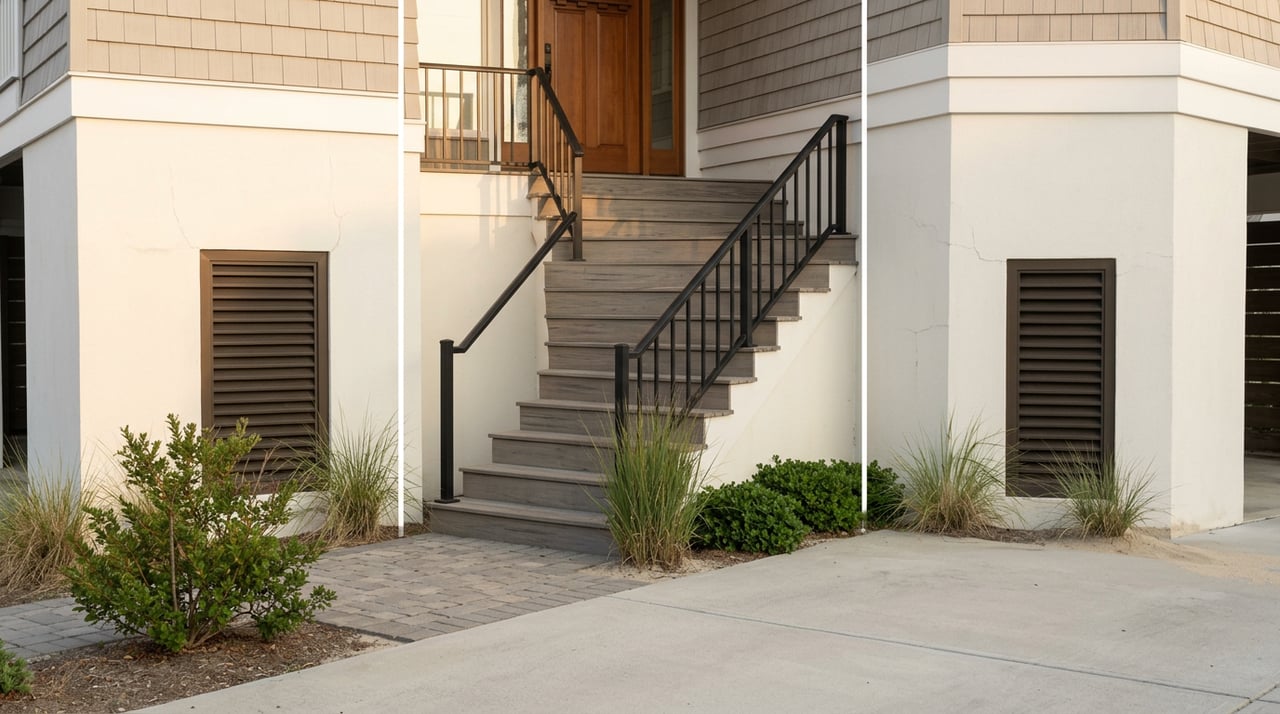
Margate's 50% Flood Rule: What Renovation Plans Need to Know
September 17, 2026
September 17, 2026
Say you buy an older cape a block off the beach in Margate. It needs work: new kitchen, updated baths, maybe a primary suite over the garage. You get a contractor quote, and the number feels reasonable for a shore property. Then the permit application comes back from the city with a question you didn't expect: does this qualify as a "substantial improvement"?
If it does, the renovation you planned turns into something else entirely. Not a remodel, but a full compliance rebuild, with the home required to meet the same flood-elevation standards as new construction. The surprising part isn't that the rule exists. It's how little of your project it actually takes to trigger it, and why that threshold sits so much closer than most buyers assume on a barrier island where the price of the dirt has almost nothing to do with the price of the house sitting on it.
The baseline comes from FEMA. Under the National Flood Insurance Program, any reconstruction, addition, or improvement whose cost equals or exceeds 50 percent of a structure's market value counts as a "substantial improvement," and the building then has to meet current flood-construction standards, meaning elevation above base flood level. That's a federal floor. Local governments can adopt it as written or make it stricter.
Margate adopted its own version through Chapter 145 of the city code, most recently rewritten in May 2023. The ordinance's definitions section is specific about what "market value" means for this calculation. It's the value of the building only, not the land, and it can be established one of three ways: actual cash value based on depreciated replacement cost, a tax-assessed value adjusted upward by the state's equalization factor to approximate true value, or a figure from a qualified independent appraiser.
That middle option, the assessed-value path, is where most homeowners will land, because it's the number already sitting on their tax card. It's also the option most likely to be misapplied, for reasons that have nothing to do with anyone being careless.
Here's the part that changes the math for Margate specifically. Because the 50 percent threshold is calculated against the building's value alone, and land is excluded entirely, the denominator in that equation is often small relative to what the property actually sold for.
Margate isn't a market where the structure carries most of the price. It's a market where the lot does. A ranking published by the Philadelphia Business Journal placed Margate as the third-hottest luxury housing market in the country, behind only Osterville on Cape Cod and Longboat Key in Florida, with the average sale price climbing to roughly $2.089 million and prices up 298 percent since before the pandemic. That kind of appreciation on a barrier island isn't driven by bigger houses. It's driven by scarcity of buildable ground. A modest 1960s cottage on a coveted block can carry a land value that dwarfs the value of the structure sitting on it.
Run that through the substantial-improvement formula and the effect is almost mechanical. If the building itself is only worth a fraction of what the parcel sold for, it doesn't take a gut renovation to cross 50 percent of that smaller number. A kitchen, two baths, and some structural work on an older, unelevated home can get there faster than the total project budget would suggest to anyone estimating against the sale price instead of the building's isolated value.
This is where the ordinance's precision matters and where a homeowner working from memory or a quick city website search can get tripped up. Margate's building department maintains a plain-language page on substantial improvement permits that describes the trigger simply: if renovation costs equal or exceed 50 percent of the building's assessed tax value, the home has to meet new-construction standards. That's accurate as far as it goes, but it skips a step the actual ordinance spells out, which is that the assessed figure has to be adjusted by the state's equalization factor before it approximates true market value.
That step isn't a technicality. New Jersey assessed values are frequently below true market value, sometimes well below it, and the gap varies by municipality and by how recently a town has been through a full revaluation. Skip the adjustment and you could be running the 50 percent math against a number that's meaningfully lower than what the ordinance actually intends, which means a renovation that looks safely under the threshold on paper might not be.
Margate has its own recent history with this exact problem. The Atlantic County Board of Taxation found in 2021 that the city's ratio of assessed value to true value carried a coefficient of deviation of 14.6 percent for residential properties, a spread wide enough that the county ordered a citywide revaluation, originally set to take effect for the 2025 tax year after the city was granted extensions tied to pandemic-era market volatility and the cost of the project itself, which the city's own tax assessor estimated at $750,000 to $1 million.
A coefficient that wide means individual assessments across town could be running well above or well below true value, not in some uniform, easily corrected direction. For a homeowner trying to figure out where their building's assessed value stands relative to the equalization-adjusted number the ordinance actually requires, that's one more reason the tax card alone isn't a reliable place to stop looking.
None of this happens in a vacuum. Margate's market right now is also unusually negotiated. By late 2025, the median list price in town sat around $1.55 million while the median sold price landed closer to $1.27 million, with homes closing at roughly 94.9 percent of asking. Days on market have been climbing too. As of September 2025, homes were taking a median of 117 days to sell, up from 79 days a year earlier, and the ultra-luxury tier above $2 million has seen some of the longest exposure times of all. By July 2026, the median asking price had drifted up again to around $1.6 million, even as buyers held more leverage on price than they had in years.
That combination, rising list prices alongside longer negotiations, tells you the market still wants the land underneath these houses. It just doesn't want to pay full price for an aging structure sitting on top of it, especially one that might trip the substantial-improvement threshold the moment a new owner tries to update it. Separately, custom builders like Margate's own Piraino Builders stay busy replacing older cottages outright rather than renovating them. New construction is automatically built to current flood standards from the first stud. There's no substantial-improvement determination to request, no ordinance definition to reconcile against a building-department FAQ, no assessed-value gap to worry about. For a lot where the land was always doing most of the work anyway, starting over sidesteps the whole calculation.
If you're buying an older, unelevated home in Margate with renovation in mind, a few steps are worth taking before a contractor's estimate becomes a signed contract.
Does a kitchen and bath remodel by itself count toward the 50 percent threshold? It depends on the total scope and cost relative to the building's isolated value, not the land or the total sale price. Structural work, additions, and mechanical upgrades typically count toward the total, while some minor maintenance items are excluded under the ordinance's definitions.
It's worth confirming zone status directly rather than assuming based on distance from the water.
If you're weighing an older Margate property against the cost of bringing it up to code, or trying to figure out what a lot is actually worth with the existing structure factored in honestly, that's exactly the kind of math Amy Reuter walks clients through before an offer goes in, not after. Let's Connect.
This article is general information, not legal, tax or financial advice. Consult a qualified professional about your situation.
Stay up to date on the latest real estate trends.

While every buyer defines privacy a little differently, there are several property features that consistently move higher on the wish list when discretion and seclusio… Read more
For a professional athlete joining a new team, the obvious answer might seem to be buying a home, particularly if the contract is significant and the player expects to… Read more

A real estate professional can help coordinate the transaction and provide property-specific information, but the legal, tax, lending and estate-planning decisions bel… Read more

For certain buyers, the most interesting house on the market may be the one that isn't actually on the market.
Amy Reuter brings together luxury-level marketing, strong negotiation, and honest guidance to help clients navigate every move with confidence. From South Jersey primary residences to South Jersey beach homes, Amy creates a thoughtful, highly personalized experience centered around strategy, communication, and results.
AMY REUTER
[email protected]
(856) 229-2473
ADDRESS
198 FRIES MILL RD
TURNERSVILLE, NJ 08012